
Article: How to Identify a Genuine Kanjivaram Saree

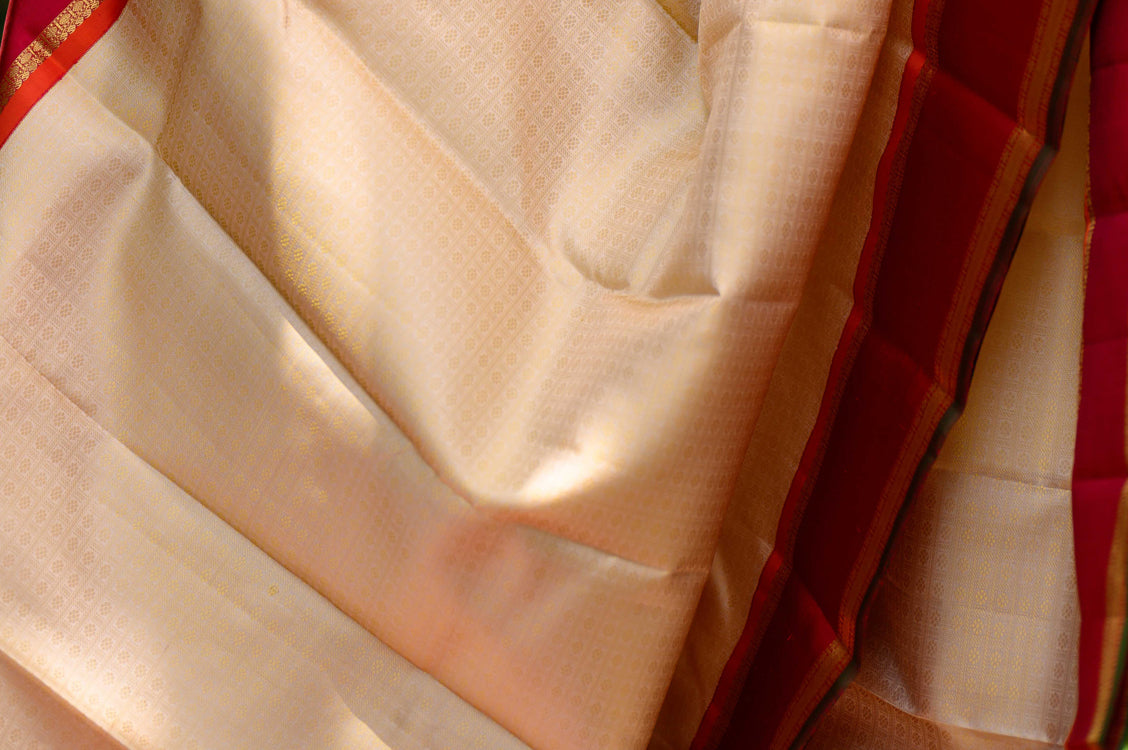
How to Identify a Genuine Kanjivaram Saree
Introduction
Kanjivaram sarees feel like a little bit of history wrapped around you — heavy, rich, and full of craft. But with so many imitations around, it's easy to get confused. This friendly guide walks you through practical, easy-to-do checks so you can tell a real Kanjivaram from a lookalike before you buy.
What makes a Kanjivaram saree special?
· Handwoven mulberry silk with a dense, structured drape.
· Distinctive borders and pallus, often in contrasting colors.
· Traditional motifs (temples, peacocks, flora) woven with care.
· Use of Zari for the motifs and borders, giving a subtle glow (not plastic shine).
Simple checks to do in-store or when you get a saree delivered
- Feel the weight and drape: A genuine Kanjivaram usually feels heavier and holds shape well. It won’t flop like a cheap synthetic saree.
- Touch the silk texture: Real silk feels smooth with a soft natural sheen — not plasticky or overly glossy
- Inspect the body-border join (korvai): Look for a visible, firm join where the body meets the border; traditional korvai joins are a good sign of handweaving
- Examine the zari: Real zari has a muted, rich glow. If the metallic thread flakes, looks excessively shiny, or shows polyester underneath, be suspicious.
- Look closely at the weave: Handwoven sarees may show tiny irregularities — that’s often a sign of craftsmanship, not a defect.
- Check the motifs: Detailed, crisp motifs woven into the fabric are better than prints or stamped designs
- Ask about provenance: Who made it, where it was woven, and whether the seller offers documentation or returns.
Quick tests you can try (use together, not alone) to check the Silk Sarees in your possession.
- Ring test: Let part of the saree pass through a ring — silk drapes smoothly. (Not foolproof; one clue among many.)
- Scratch the zari lightly in an inconspicuous spot: real zari shouldn’t flake easily. (Do this only if you’re allowed.
- You could take a small part of the fabric and do a burn test. If you the piece burns completely leaving only ash and smells like burning hair, then it is most likely pure silk. The art silk gives out a smell resembling that of burning plastic and leaves a residue.
How to read common red flags
- Too shiny, plasticky finish (especially under light): often synthetic.
- Perfectly uniform weave with no small variations: possible power-loom production.
- Very low price for what looks like heavy silk and gold zari: likely an imitation.
- Evasive seller who won’t confirm fabric or zari details: walk away.
Buyer checklist (print this or keep handy)
Silk Mark label present? Yes/No
Saree feels heavy and structured? Yes/No
Natural silk texture (not plastic)? Yes/No
Visible korvai/body-border join? Yes/No
Zari looks rich, not flaking? Yes/No
Motifs woven, not printed? Yes/No
Seller provides provenance/returns? Yes/No
Have they tested the Zari at the Testing Centers in Kanjivaram? Yes/No
FAQ
- Is Silk Mark the only proof I need? Silk Mark is a strong indicator but combine it with tactile and visual checks for confidence.
- Can I trust online photos? Photos help but ask for close-up shots of the border and, pallu, and a photo of the Silk Mark tag. Request a short video to judge drape.
- Do genuine Kanjivarams always cost a lot? Many authentic pieces are premium-priced because of labor and real zari; however, price varies by silk quality and design complexity. The handwoven Kanjivaram sarees are labour intensive and take time. The prices are impacted by the price of Silver and Gold as well.
- Are power-loom Kanjivaram-style sarees always bad? Not necessarily — they can look nice and be budget-friendly, but they are not the same as handwoven Kanjivaram in craft value or long-term durability.
Quick styling tip
Pair an authentic Kanjivaram with simple gold or temple jewelry and a neat bun to highlight the saree’s rich weave and motifs.
Leave a comment
This site is protected by hCaptcha and the hCaptcha Privacy Policy and Terms of Service apply.